Even when teams adopt identical large language models such as GPT-4 or Claude, the reliability of their AI Agents can differ drastically. Some agents run stably in production, while others repeatedly fail during practical tasks. The root cause does not lie within the model itself, but in the surrounding system known as Harness.
A notable set of quantitative evidence illustrates this gap: when only the Harness design is adjusted while keeping the underlying model unchanged, the score on a foundational coding benchmark can jump from 6.7% to 68.3%. This stark performance shift highlights the critical value of Harness engineering and motivates a comprehensive dissection of its six-layer architecture.
Harness Engineering has emerged as one of the most pivotal paradigm shifts in the AI Agent domain between 2025 and 2026. Its core formula can be summarized concisely:
> Agent = Model + Harness
The large language model acts as the reasoning brain of an agent, whereas Harness serves as the functional body that enables the brain to execute tangible work. It encapsulates tool interfaces, context management, state persistence, permission control, observability, and failure recovery — six core components corresponding to the six architectural layers covered in this analysis. This framework aligns with academic research such as the MemoHarness paper, which formalizes Harness as a six-dimensional model; this article translates that theoretical framework into actionable engineering practices.
This paper systematically unpacks each layer of the Harness architecture, clarifying the core problems each layer addresses and listing real-world engineering implementations. It serves as a practical reference for practitioners who want to build production-grade, stable AI Agents.
Overview of the Six-Layer Harness Architecture
The overall Harness stack is structured as six sequential, interdependent layers built on top of the reasoning model:
- Context Management Layer
- Tooling & Execution Layer
- Orchestration Layer
- State & Memory Layer
- Evaluation & Observability Layer
- Constraint & Recovery Layer
A fundamental principle guides this entire stack: the underlying model determines the upper performance limit of an agent, while Harness defines the lower bound of its real-world delivery quality. Even state-of-the-art models will produce unreliable outputs without a well-designed Harness system. In multi-model agent systems, routing and managing diverse model requests can be streamlined with an API gateway like Treerouter to standardize traffic and access control.
Layer 1: Context Management
The primary goal of the context management layer is to ensure the model receives only the most relevant information within its finite context window.
Modern LLMs support context windows of 200K tokens or even 1M tokens, yet dumping all available information into the prompt remains poor engineering practice, driven by three key constraints:
- Lost in the Middle Effect: Models exhibit degraded attention to critical information positioned in the middle of lengthy prompts, which becomes more severe as context length increases.
- Escalating Operational Costs: Each API call carrying hundreds of thousands of tokens accumulates substantial billing overhead for high-frequency agent workflows.
- Noise Interference: Extraneous text dilutes core instructions, making it harder for the model to prioritize key objectives.
Four mature engineering practices resolve these challenges:
- Dynamic Context Assembly: Before each model invocation, retrieve relevant file content, historical decisions, and previous tool outputs based on the current task state.
- Context Compression: Automatically summarize and evict older conversation history as the token limit nears, preventing long-running sessions from spiraling out of control.
- Hierarchical Loading: Core system prompts remain persistently loaded; working memory is fetched on demand; long-term memory is retrieved via query. The three tiers follow independent loading strategies.
- Structured Chunking: Split large documents into semantic segments, and inject targeted chunks via embeddings or keyword search, rather than loading full files into the context window.
For engineering teams prioritizing quick returns, context management is often the highest ROI optimization within the Harness stack. Optimizing this layer simultaneously reduces inference costs and improves output consistency.
Layer 2: Tooling & Execution Layer
This layer governs how an agent accurately invokes external tools and translates textual model outputs into actionable operations.
LLMs produce outputs in plain text by default. Without standardized tool interfaces and execution sandboxes, the model cannot interact with external systems, databases, or local environments. The tooling layer defines the physical capability boundary of the agent; no tooling means the agent cannot complete tasks beyond text generation, regardless of model quality.
Four core engineering practices for this layer:
- Precise Tool Definition: The tool name, parameter schema, and descriptive documentation directly impact the accuracy of model tool invocation. Ambiguous descriptions are a leading cause of failed tool calls.
- Execution Sandboxing: Code execution, shell commands, and browser automation must run within isolated environments to prevent agents from modifying or damaging host infrastructure.
- Structured Feedback for Tool Results: Success signals, error stacks, and output summaries must be formatted for model comprehension. Raw unprocessed log text often cannot be parsed effectively by the LLM.
- MCP Protocol Adoption: The Model Context Protocol (MCP) is rapidly becoming the industry standard for reusable tool integration, enabling a single tool implementation to be shared across multiple agent systems.
Layer 3: Orchestration Layer
The orchestration layer defines the workflow logic that sequences reasoning, tool invocation, and observation. The ReAct (Reason-Act-Observe) loop is the most widely adopted foundational pattern for single-agent orchestration.
A robust ReAct loop must explicitly handle four critical failure modes to avoid infinite loops or silent failures during long-running tasks:
- Termination Criteria: Completion cannot rely solely on the agent self-reporting that a task is finished. Verifiable, objective acceptance standards must be predefined.
- Exception Handling: Predefined rules govern behavior when the agent hits roadblocks: automatic retry, graceful termination, or escalation for human review.
- Resource Quotas: Hard limits on total execution steps and runtime prevent unbounded looping that consumes excessive tokens and compute resources.
- Auditable Execution Logs: A complete trace of every reasoning and action step must be retained to debug deviations in agent behavior.
A minimal viable ReAct implementation can be built with only a few lines of code:
for step in range(max_steps):
    model_output = invoke_llm(context)
    action_type = parse_action(model_output)
    result = execute_tool(action_type)
    context = update_context(context, result)
    if check_termination(context):
        break
Teams are advised to validate this basic loop first before adding more complex multi-agent planning logic.
Layer 4: State & Memory Layer
This layer enables agents to retain task progress, historical decisions, and persistent knowledge, which is the core distinction between stateful agents and stateless chatbots. A regular chatbot forgets prior context once a session ends, while an agent carries accumulated state throughout the lifecycle of a task.
Agent memory is split into three distinct categories with separate lifecycles:
| Memory Type | Core Purpose | Lifecycle |
| ---- | ---- | ---- |
| Working Memory | Tracks real-time task progress, intermediate variables, current execution status | Bound to a single active task |
| Session Memory | Preserves multi-turn dialogue history and in-session context | Bound to one user session |
| Long-Term Memory | Stores cross-session knowledge, user preferences, reusable experience | Persistent across sessions |
Three key design considerations guide memory implementation:
- Isolate Transient and Persistent State: Prevent temporary task variables from being written into long-term memory, which pollutes knowledge for subsequent unrelated tasks.
- Resumable Task Checkpoints: Persist state snapshots so interrupted workflows can resume from the last valid progress point.
- Budget Control for Aggregated Consumption: Track cumulative token usage, cost, and latency across the full task lifecycle; per-request metrics may look acceptable, but aggregated consumption can become prohibitive.
Layer 5: Evaluation & Observability Layer
Observability is the foundation for iterative agent improvement. Without measurable signals, teams cannot objectively assess whether an agent is performing correctly or identify root causes of failure. This layer makes agent actions traceable, comparable, and auditable, serving as the single source of truth for quality evaluation.
Four core signal categories need to be captured:
- Execution Traces: Full input, output, and tool invocation history for every reasoning cycle.
- Success Signals: Confirmation that predefined task completion criteria have been satisfied, aligning with the validation rules defined in the orchestration layer.
- Failure Modes: Document the scenarios that trigger errors and their root causes; failure patterns are the most valuable source for iterative optimization.
- Cost & Latency Metrics: Track token consumption, response delay, and monetary overhead for capacity planning and cost forecasting.
Three standard engineering practices:
- Independent Validation Mechanisms: Implement a separate judge workflow to score agent outputs, rather than relying on the generative model to self-evaluate its own work.
- Full Logging for Tool Invocations: Persist all input parameters, return values, timestamps, and error messages for every external tool call.
- End-to-End Traceability: Use a consistent trace ID propagated through every step of execution to enable rapid troubleshooting of complex failure chains.
Layer 6: Constraint & Recovery Layer
The constraint and recovery layer acts as the final safety guardrail of the Harness system. It intercepts risky behavior before execution and defines remediation strategies when the agent fails. This layer includes four core mechanisms:
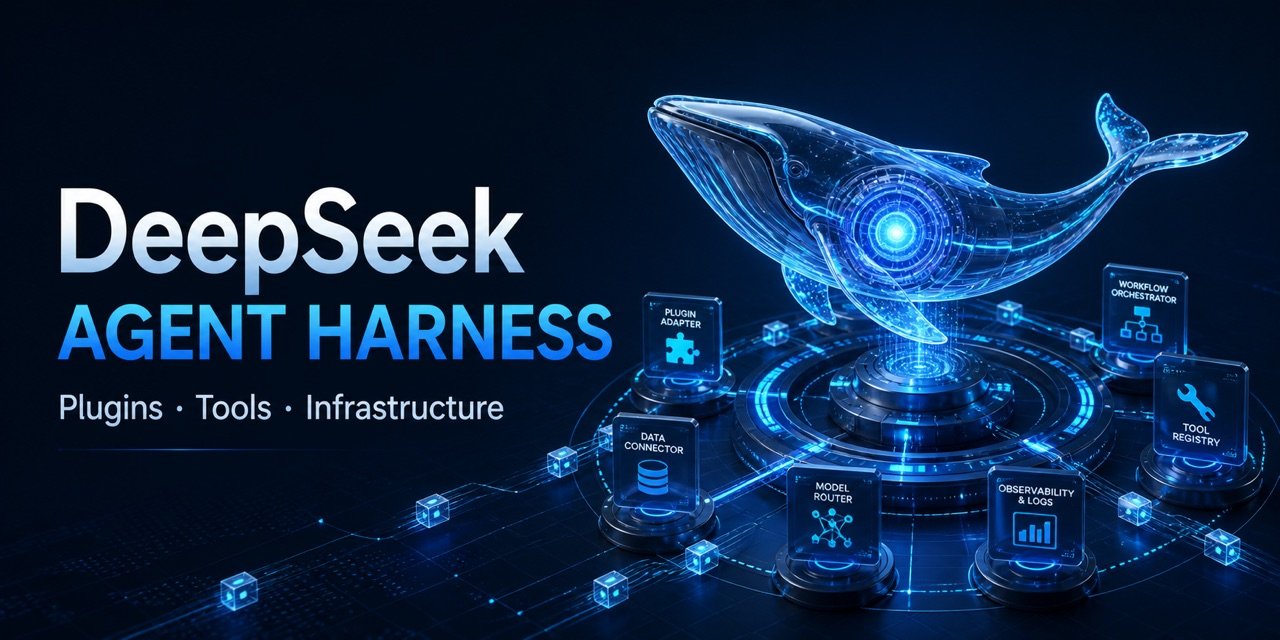
- Permission Hierarchy: High-risk actions such as file modification, shell execution, and external API calls are gated by approval policies. Granular access rules can be configured for each action type, as implemented in frameworks like DeepSeek Harness.
- Error Recovery Logic: Predefined remediation paths for different failure categories: automatic retry, state rollback, or graceful degradation, rather than applying a universal handling rule for all errors.
- Guardrails & Rate Limiting: Input and output sanitization, token caps, and execution quotas prevent runaway agent behavior.
- Non-Recurring Fixes: When an agent encounters a bug, engineer a systemic resolution to ensure the identical error cannot occur again in future runs.
This definition aligns with Mitchell Hashimoto, creator of Terraform: *Whenever an agent makes a mistake, invest effort to design a solution that prevents the agent from repeating that exact error*.
Implementation Priority Roadmap
Teams do not need to build all six layers from day one. The rollout can follow a phased roadmap aligned with project maturity:
| Priority | Layers | Description |
| ---- | ---- | ---- |
| P0 (Highest) | L1 Context Management + L6 Constraint & Recovery | Build the foundational baseline: ensure the agent understands task requirements and contains failure risks. This delivers the fastest return on engineering investment. |
| P1 (Post-Baseline) | L2 Tooling + L4 State & Memory + L5 Evaluation | Add reliable tool invocation, persistent task state, and quantitative evaluation capabilities after the core baseline stabilizes. |
| P2 (When Resources Allow) | L3 Orchestration + Advanced Enhancements | Implement multi-agent collaboration, complex planning, and periodic performance iteration for mature production workloads. |
The recommended build sequence starts with P0 layers to establish a stable baseline before investing in sophisticated orchestration and multi-agent workflows.
Conclusion
Harness Engineering is the collection of engineering patterns that enable LLMs to deliver consistent, usable work in real environments. The model defines the theoretical ceiling of agent capability, but Harness dictates the practical lower bound of delivery quality. The user experience and business value of AI agents are ultimately determined by the robustness of this surrounding system.
The core construction sequence can be condensed into three stages: first, ensure the agent understands its objectives clearly; second, implement safeguards to recover from errors; finally, continuously enhance its capabilities through observation and iteration. Starting from the context management layer, teams can incrementally build a mature, production-ready Harness stack for AI agents.
Learn more:https://treerouter.com