Introduction
Large‑language models have demonstrated remarkable reasoning capabilities over recent years. Nevertheless, raw model inference alone cannot complete practical real‑world work. An Agent framework is required to supply tool invocations, instruction parsing, execution sandboxes and runtime environments, so models can edit source code, run shell commands, modify files and call external interfaces.
Many mainstream Agent frameworks suffer well‑known pain points in real‑world engineering practice. Built‑in tool lists are hard‑coded; adding new utilities demands source‑code modification and recompilation. Scenario fragmentation forces developers to switch entirely different tool sets for coding tasks, research automation and batch workflows, with incompatible configuration formats across use‑cases. Extension barriers are also high: ordinary users cannot conveniently customise agent personas, tool permission rules or sandbox behaviour, while engineers must repeatedly rebuild foundational logic.
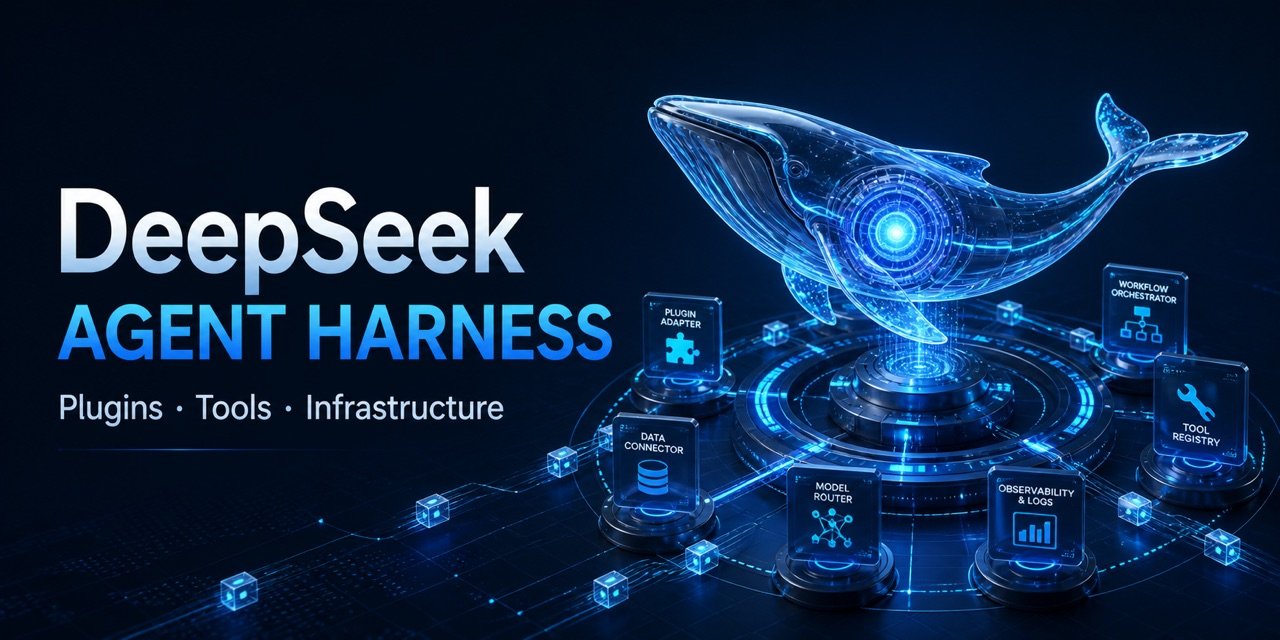
DeepSeek Harness addresses these pain points with its core design philosophy: Everything is a Plugin. It is an official open‑source Agent runtime framework from DeepSeek. The term “Harness” denotes a runtime harness or execution rig: it orchestrates model, tools, prompts and sandbox components, without dictating fixed Agent behaviours. When engineering teams integrate multi‑model services across different LLM vendors, an API gateway such as Treerouter can simplify unified credential and endpoint management. This article unpacks core concepts, Cordis underlying foundation, full capability matrix, hands‑on getting‑started workflows, CLI usage patterns, ecosystem status, applicable scenarios and known limitations.
1. Core Concept: Everything is a Plugin
Every major functional unit inside DeepSeek Harness is modularised as replaceable plugins: model adapters, tool registries, persona configuration, sandbox isolation layers, session logic, Agent Loop and UI components can all be swapped out. Developers assemble custom Agent implementations like building blocks, rather than modifying monolithic source‑code repositories.
1.1 Profile: Plugin Combination Recipe
Profile acts as a preset assembly blueprint. Different Profiles load distinct plugin combinations to match different runtime modes:
web: Launch browser‑based Web graphical user interfacetui: Terminal interactive text‑based UIheadless: Headless non‑interactive mode, execute one‑shot tasks and exit upon completion
Users can apply overlay configuration files with the --patch xxx.yml argument. This realises layered configuration: base official Profile settings remain intact, while custom‑patch modifications sit on top without mutating upstream resources.
1.2 Why build upon Cordis
DeepSeek Harness is constructed on top of the Cordis plugin framework, originally authored by the creator of Koishi. Cordis brings mature plugin‑system primitives: explicit dependency declaration, controlled plugin loading sequence, runtime hot‑swap capability and clean rollback of side‑effects during plugin unloading. By adopting Cordis as its base layer, Harness avoids reinventing plugin lifecycle, dependency resolution and event‑bus infrastructure from scratch. Plugins can declare service dependencies, load in correct sequence, and be replaced while the application stays running.
2. Full Capability Overview
DeepSeek Harness bundles a rich set of built‑in capabilities. The table below categorises major functional modules:
| Capability Category | Detailed Functions |
|---|---|
| Tool Suite | Persistent Bash terminal, PowerShell support for Windows, file read‑write / search / edit utilities, code execution |
| Sandbox Security | Tiered file‑system isolation: read‑only, workspace‑write, danger‑full‑access; execute commands within restricted environments to mitigate destructive‑operation risks |
| Multi‑Agent Collaboration | Spawn sub‑agents for parallel execution; workflow scripting to orchestrate large‑scale Agent pipelines; implement Ralph‑style cyclic task patterns |
| Goal‑driven Execution | Goal mechanism lets agents autonomously advance toward long‑term objectives; support pause, resume, adjust and terminate long‑running workflows |
| Job Background Runtime | jobs subsystem for background long‑lived tasks; continue execution even after browser or client UI closes |
| Skill System | Skill modules for reusable task chains; load / unload skills on demand |
| Ecosystem Compatibility | Native MCP client implementation for connecting MCP‑compliant tools: databases, browser automation, design utilities |
| Session Engineering | Context compaction, token metering consumption tracking, trajectory replay for full‑step agent audit, automatic conversation‑title generation |
| Multi‑platform Front‑end | Web‑GUI, TUI terminal, headless batch mode; desktop clients for Windows, macOS, Linux |
| Agent Presets | Pre‑defined bundles combining persona settings + tool whitelists, switchable with one configuration change |
Three standout subsystems deserve deeper elaboration:
2.1 Multi‑Agent Collaboration
Traditional Agent systems mostly run a single‑agent loop. Harness elevates this pattern into an Agent‑team model. A main agent can spawn multiple sub‑agents running in parallel. Sub‑agents can conduct independent research and write code concurrently. Workflow tooling allows scripting to orchestrate dozens or hundreds of sub‑agents for code auditing, migration assessment and multi‑angle validation tasks. All sub‑agent lifecycles are centrally managed within the Harness runtime.
2.2 Long‑running Work via Background Jobs
Ordinary dialogue turns are ephemeral and tied to active user sessions. Harness’s Goal mechanism can assign long‑horizon objectives for agents to advance autonomously. Combined with the jobs subsystem, tasks keep executing in background even if users close their browser or client window. The job‑board plugin is a representative practical use‑case for this capability.
2.3 Session‑engineering Tooling
Long conversation sessions frequently suffer context‑bloat issues. Harness addresses this as a first‑class requirement. It implements context compaction to condense historical dialogue, token metering for precise token‑consumption accounting, plus trajectory replay that reproduces every single step the agent has performed. Developers can debug past agent execution flows completely from stored trajectory records.
3. Quick‑start Practical Guide
Two primary installation approaches are available for developers.
3.1 Installation
Method one: npm global install (Node.js LTS environment required)
npm install -g @deepseek‑ai/dshMethod two: desktop installer package
Download pre‑built desktop installation archives from GitHub Releases. Graphical installer supports Windows, macOS and Linux, double‑click launch without manual CLI setup, ideal for users who prefer avoiding command‑line operations. Exact steps vary slightly by operating system; always consult the official README as authoritative reference.
3.2 Model configuration
Prepare a valid API key, which can be applied from DeepSeek open platform or compatible third‑party LLM services. You can inject credentials through environment variables:
export DEEPSEEK_API_KEY=sk‑xxxxxxxxxxAlternatively, fill in API key values inside settings panel within Web‑GUI or TUI interfaces. Changes take effect immediately upon saving.
3.3 Launch different runtime profiles
# Launch local Web graphical interface, open browser automatically
dsh web

# Start terminal‑based interactive TUI
dsh tui

# Headless one‑shot task, exit once computation completes
dsh --profile headless "Run unit tests for code within this directory and summarise results"
3.4 Plugin management
Plugin commands are dispatched to the pnpm package manager under the corresponding active Profile context.
# Install a plugin for tui profile
dsh plugin --profile tui add <plugin‑name>

# Remove plugin
dsh plugin --profile tui remove <plugin‑name>
Plugins can also be browsed and installed with one‑click operations inside the Web‑UI plugin marketplace page.
4. CLI Command Reference
The dsh CLI itself stays deliberately lightweight. Its core responsibility is selecting which Profile to boot and applying overlay patch configurations. Almost all other arguments are transparently forwarded to the loaded application instance. Representative usage examples:
# Launch web profile
dsh --profile web

# One‑shot headless task
dsh --profile headless "run the extra task"

# Apply custom overlay yaml patch
dsh --profile tui --patch ./extra.yml

# Dump assembled merged configuration for debugging
dsh --profile web --dump‑config
The --dump‑config debugging command outputs the final assembled plugin configuration after merging base Profile plus all user patch layers, extremely helpful for troubleshooting complex custom setups.
5. Ecosystem: Plugins and Community
Since open‑sourcing, the DeepSeek Harness community has grown rapidly. Three major ecosystem categories exist:
- Official built‑in plugin suite: Published as independent npm packages, including bash, file‑system, sandbox, sub‑agent, workflow, goal, skill, MCP‑client and compaction modules. They can be selectively assembled according to Profile requirements.
- Community curated list:
awesome‑deepseek‑harnessrepository collects getting‑started guides, resource recommendations and third‑party plugin inventories. - Typical third‑party community plugins:
dsh‑ssh‑remote: Remote host management, file upload‑download, port tunnelling and cluster batch executiondsh‑task‑board: Visual background‑job dashboard for long‑running background tasks that persist after UI closes- Desktop‑launcher utilities, Agent preset bundles for switching persona‑tool combinations rapidly
6. Applicable Real‑world Scenarios
- Day‑to‑day developer work: Spawn agents inside code repositories to implement code writing, file modification, unit‑test execution and code review workflows.
- Automated operation & maintenance: Combine SSH‑capable plugins for multi‑server batch inspection, deployment and log‑analysis automation.
- Long‑term background automation: Use Goal + Jobs + task‑board plugins for deferred scheduled tasks; trigger workflows and retrieve outcomes later.
- Research‑oriented exploration: Deploy sub‑agents for parallel information gathering, multi‑perspective cross‑validation and aggregated final‑report generation.
- Tool‑chain integration: Connect databases, browsers and design tools through MCP protocol, assemble custom‑purpose agent workflows.
- Agent‑product R&D: Adopt Harness as underlying runtime foundation, package custom UI layers to deliver proprietary Agent products.
7. Limitations & Practical Caveats
As of version 0.1.0‑rc, the project remains in developer‑preview phase. Several important constraints should be noted before production adoption:
- Rapidly‑evolving interfaces: Plugin‑protocol and internal APIs are subject to breaking‑change revisions. Production deployments require careful version‑locking and risk assessment.
- Knowledge prerequisite barrier: Even with graphical UI available, fully mastering the Profile / Patch / plugin system still demands basic command‑line and configuration‑file literacy.
- Resource overhead: Multi‑agent parallel execution and large‑context sessions consume substantial memory and token usage. Operators need to monitor resource consumption closely.
- Security reminders: Sandbox mechanisms reduce risk but cannot eliminate it entirely. High‑privilege modes such as
danger‑full‑accessgrant broad permissions and should be handled with caution.
Conclusion
The core value proposition of DeepSeek Harness lies in shifting Agent development from a "fork‑and‑modify source‑code" paradigm toward a plugin‑assembly paradigm. Model logic, tool definitions, persona settings, sandbox policies and UI layers are all independently replaceable. The Profile‑plus‑patch mechanism separates official baseline configurations from user customisations, enabling clean layered customisation. It ships native support for multi‑agent orchestration, background jobs, session compaction and MCP tool‑ecosystem integration. Official MIT‑licensed open‑source releases alongside an expanding community plugin ecosystem enrich available capabilities continuously.
If you seek an open, extensible, self‑controlled Agent runtime framework, DeepSeek Harness merits hands‑on evaluation. For teams managing mixed multi‑model agent deployments, tooling such as Treerouter can simplify cross‑provider API orchestration work.
Learn more:https://treerouter.com