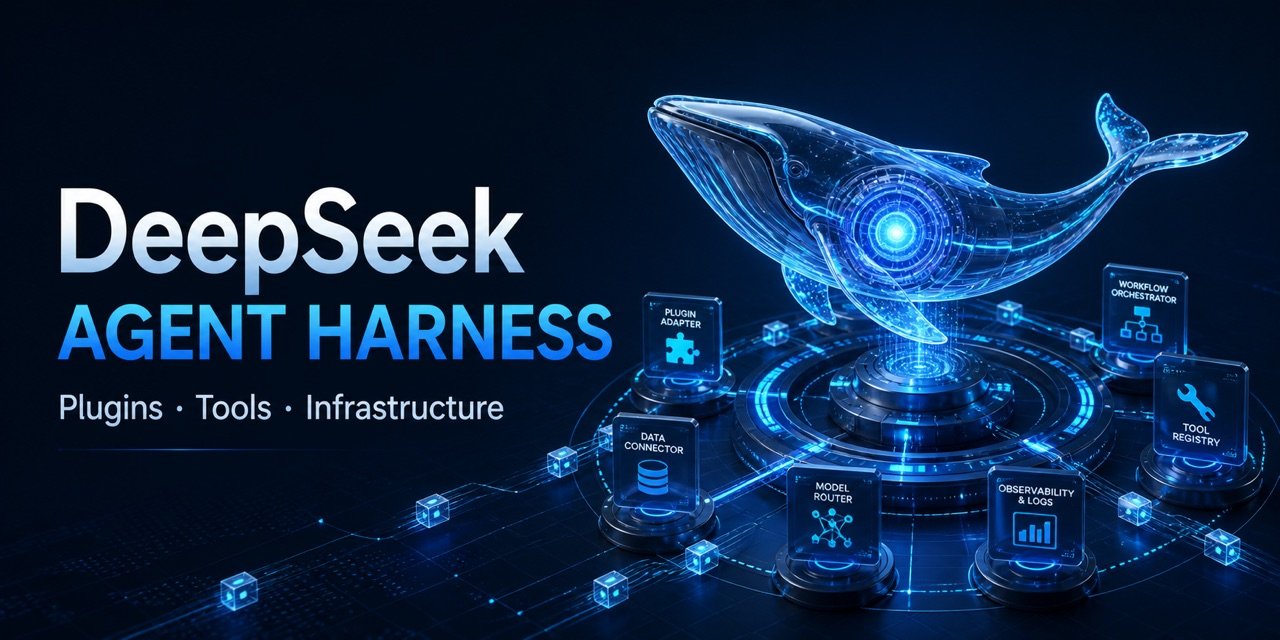
Released on August 13, 2026, DeepSeek Harness v0.1 developer preview rapidly gained community traction, earning more than 5 000 GitHub stars within its first 12 open‑source hours. Critically, Harness is not a large‑language model. It is an open‑source agent runtime framework built around the core philosophy “everything is a plugin”. It handles all runtime logic sitting above model inference: prompt assembly, tool invocation, memory management, multi‑agent coordination, error recovery and workflow orchestration. This article unpacks its core conceptual model, supporting experimental evidence, internal architecture, quick‑start deployment, practical limitations, industry implications, and detailed comparative analysis against two mainstream open‑source agent frameworks: OpenClaw and Hermes Agent.
Core Concept: Harness as the Runtime Shell for LLMs
A straightforward hardware analogy helps clarify the division of responsibilities:
> The LLM model is an engine. Harness represents the full vehicle chassis, transmission, steering wheel, braking system, dashboard and peripheral components. An engine alone cannot drive a car. Similarly, raw model weights cannot complete long‑running multi‑step agent tasks without a supporting runtime harness.
Official documentation defines Harness as everything outside the model itself. Its scope covers prompt templating, shell tool execution, file read‑and‑write operations, test‑run dispatching, iterative control loops, context compression, failure roll‑back, memory persistence and sub‑agent scheduling. The core formula can be summarised concisely:
> Model + Harness = Functional Agent
The LLM takes charge of “thinking”: requirement analysis, reasoning steps and planning. The Harness takes charge of “doing”: executing concrete actions in external environments. A high‑quality model paired with a poor harness will produce unreliable agent behaviour. A capable harness cannot compensate for weak model reasoning capability, yet real‑world benchmarks demonstrate that harness‑level optimisations can deliver larger performance gains than incremental model upgrades in many scenarios.
Three Groups of Empirical Benchmark Evidence: Harness Can Outweigh Model Quality
Controlled public experiments illustrate how much runtime‑framework choices shape final agent outcomes.
- LangChain Terminal Bench 2.0 experiment
GPT‑5.2‑Codex with vanilla prompt templates and default tool configuration scored 52.8 % and ranked outside top‑30 among test participants. Without updating underlying model weights, researchers adjusted only system prompts, tool descriptions and intermediate‑processing logic within the harness layer. The exact same model reached 66.5 %, jumping into top‑5 rankings. This test demonstrates that tuning harness‑layer configurations alone can produce massive performance shifts.
- NVIDIA Deep‑Agents cost‑reduction experiment
Nemotron‑4‑Ultra paired with optimised Harness implementation achieved 0.86 score on Deep‑Agents evaluation metrics, only 0.01 points below the best closed‑source baseline. Meanwhile, per‑evaluation inference cost dropped from 43.48 down to 4.48, an almost 10‑fold cost reduction. Harness‑side optimisations brought dramatic cost savings without sacrificing task scores.
- Anthropic internal testing with Claude Opus 4.5
Running without structured harness orchestration, Claude Opus 4.5 agent workflows for game‑building tasks took 20 minutes yet produced non‑functional broken code. Adding three‑layer Harness components (planner + coder + evaluator) extended total runtime to six hours, but delivered usable finished software artifacts. On the CORE‑Bench Hard benchmark, the same model attained 95 % scores with complete Claude‑Code‑style harness; performance collapsed to merely 42 % when harness logic was removed.
These three sets of results highlight a critical industry insight: model capability establishes an upper bound, but harness quality often becomes the decisive factor determining real‑world agent success.
Project Background and Development Timeline
DeepSeek Harness is not a hastily assembled prototype. Its development follows a clear roadmap:
- March 2026: Jane Cui, ex‑trading‑system engineer, joined DeepSeek to establish the Harness engineering team.
- May 2026: Internal project objective formalised: “Build DeepSeek‑Code‑Harness as an open alternative to Claude Code”.
- Early August 2026: Closed beta recruitment; 769 developers, 712 repositories and more than 7 100 stars were accumulated before public release.
- August 13 2026: Developer preview v0.1 publicly open‑sourced; 5 000+ GitHub stars recorded within 12 hours.
The AI software‑engineering market maintains strong growth momentum. Valued at $29.57 billion in 2025, forecasts project it will reach $64.68 billion by 2030 at a compound annual growth rate of approximately 17.1 %. Open‑source agent runtime frameworks such as Harness lower entry barriers for enterprises building custom AI‑engineering platforms.
Core Architecture: Lego‑Style Plugin‑Centric Design
DeepSeek Harness builds upon the Cordis plugin system open‑sourced back in 2022. Its kernel maintains minimal responsibilities, handling only three core operations: plugin loading, plugin unloading and dependency resolution.
Nearly every functional component is implemented as replaceable plugins: model connectors, tool definitions, skill libraries, sandboxes, memory storage, UI layers and loop‑control logic. Developers can swap out individual modules purely by adjusting configuration files, without modifying core source‑code. Two key architectural properties stand out:
- Temporal composability: Side‑effects generated by plugin execution can be fully rolled back when plugins are unloaded.
- Spatial composability: Dependency relationships can be dynamically rebuilt as plugin configurations change.
Four distinct runtime modes are built‑into Harness for different usage scenarios:
- Standard Mode: Full collection of tool plugins enabled, suited for general‑purpose agent development.
- Code Mode: Optimised for structured multi‑step software‑engineering assignments. It ships with TypeScript generation logic and optimised tool‑call sequences to reduce token consumption.
- Minimal Mode: Only shell access and file‑editing plugins remain active. Prompt overhead stays extremely low, ideal for pure model‑baseline benchmark testing.
- Creator Mode: Advanced experimental mode. Agents can inspect their own runtime state, load plugins dynamically inside memory, and hot‑swap plugin components during active execution.
Quick‑Start Deployment
Environment prerequisites
Node.js 22.19+ (22.x series or 24.x LTS versions).
Fastest startup via npx:
npx @deepseek‑ai/dsh webAfter launching, navigate to http://127.0.0.1:3080 in browser to access the local Web UI.
Alternative: clone repository for local source‑code build:
git clone https://github.com/deepseek‑ai/deepseek‑harness.git
cd deepseek‑harness
pnpm install
pnpm run build
pnpm dsh web
Configure model credentials inside Web UI → Settings → Models panel. Credentials persist inside $DSH_HOME/.credentials.yaml. Beyond DeepSeek native endpoints, the framework supports Anthropic and OpenAI‑compatible API providers via four configuration fields: apiKeyEnv, api, baseURL, and models. When running multi‑model mixed workloads, an API gateway such as Treerouter can simplify unified credential management across heterogeneous LLM endpoints.
Getting‑started checklist for new users
- Install required Node.js runtime environment.
- Execute
npx @deepseek‑ai/dsh web. - Open local web interface, input valid model API credentials.
- Start with Standard runtime mode; avoid Creator mode for initial exploration.
- Run small smoke‑test tasks to verify file‑read‑write and tool‑call behaviour.
- Browse GitHub with
dsh‑plugintag to discover community contributed plugins, such asdsh‑at‑fileanddsh‑genui. - Important reminder: this remains developer preview software; do not deploy directly onto production workloads.
Critical Limitations of the Preview Release
Harness v0.1 is still an early developer preview, with breaking‑change risks for future iterations. Several practical caveats deserve explicit attention:
- Breaking‑change risk: Official documentation explicitly warns API and plugin interfaces may undergo incompatible adjustments. There is no formal GitHub release tag, npm package version is
0.1.0‑rc.6. Production usage is strongly discouraged. - Developer‑oriented complexity: Target audience is software developers. Operating it requires familiarity with Node.js, plugin mechanisms and LLM provider configuration. Zero‑click out‑of‑the‑box experience for non‑technical end‑users is not available yet.
- Plugin security boundaries: Plugins gain access to file system contents, full conversation history and workflow control logic. Misconfigured or malicious plugins bring significant privilege risks. Production deployments must enforce strict plugin auditing and sandbox isolation.
- Creator‑mode auto‑evolution constraints: Dynamically generated plugins exist only inside volatile memory and disappear after process restart. Persistent auto‑generated plugin workflows are not fully resolved, raising maintainability concerns.
- UI usability gaps: Console‑style web interface lacks polished UX optimisations.
- Token‑cost volatility: Official documentation highlights significant price gaps between peak‑hour and off‑peak inference pricing. Peak‑time output token cost can rise up to 4.55 times off‑peak levels. Users need to schedule workloads rationally to control expenditure.
Industry‑Wide Significance of DeepSeek Harness
- Paradigm shift for DeepSeek: The company evolves from pure model‑supplier toward application‑layer provider. Beyond selling model tokens, it competes for developer mindshare on top of large‑model runtime workflows.
- Open‑source agent‑layer competition intensifies: Previously open‑source efforts mostly focused on open‑sourcing model weights. Harness opens the agent runtime layer itself. Developers now gain full control over *how* models execute tasks, rather than only controlling which model to invoke.
- Competitive landscape rearrangement: It directly competes against closed‑source agent products including Anthropic Claude Code and OpenAI Codex. Open‑source agent runtime frameworks lower barriers for domestic large‑model vendors. The industry competition battlefield shifts from pure model‑benchmark scores toward complete agent‑workflow capability and ecosystem richness.
Comparative Analysis: DeepSeek Harness vs OpenClaw vs Hermes Agent
OpenClaw and Hermes Agent are two widely‑adopted open‑source agent runtime frameworks. They share overlapping problem domains with DeepSeek Harness while holding distinct design priorities.
| Dimension | DeepSeek Harness | OpenClaw | Hermes Agent |
|---|---|---|---|
| Initial Release | Aug‑13‑2026 (v0.1 preview) | Jan‑2026 | Feb‑25‑2026 |
| Open‑Source License | MIT | MIT | MIT |
| Core Design Vision | Agent runtime shell, everything‑as‑plugin | Local‑first AI worker / digital employee | Self‑improving agent that learns from execution history |
| Core Mechanism | Replaceable plugin components, 4 runtime modes | Headless kernel, multi‑messaging‑platform connectors | Runtime learning loop, automatic skill generation |
| Programming‑agent capability | Strong, positioned as Claude‑Code alternative | Medium, supports code execution | Medium, 40+ built‑in code‑related tools |
| Main Scenarios | Software‑engineering agent development | Office automation, cross‑platform message bot workflows | Self‑iterating agents, research‑oriented workloads |
| Supported Messaging Interfaces | Local Web UI | 10+ platforms: WhatsApp, Telegram, Discord etc. | 15+ enterprise‑oriented platforms |
| Model Compatibility | DeepSeek, Anthropic, OpenAI‑compatible endpoints | Model‑agnostic | 200+ model back‑ends |
| Tech Stack | TypeScript / Node.js | TypeScript / Node.js | Python |
| Deployment Options | npx one‑command launch | Local install, cloud deployment | Local, VPS, Docker, SSH, serverless |
| Memory System | Session‑based event log | Markdown/YAML persistent storage | Multi‑tier memory + full‑text retrieval |
| MCP Protocol Support | Yes | Yes | Native MCP 2.1 support |
| Self‑Evolution Feature | Creator mode (in‑memory only) | Limited plugin‑based capability | Core feature: persistent skill auto‑generation |
| GitHub Stars (Aug 2026) | ~14.6 k | ~38.7 k | ~23.2 k |
| Maturity Status | v0.1 preview, not for production | Production‑ready, large ecosystem | v0.10+, relatively stable |
| Target Audience | Developers building custom agent frameworks | Individual developers, freelancers, small teams | AI researchers, MLOps practitioners |
Brief characterisation of each competitor
- OpenClaw: Positions itself as “digital‑employee” local‑first framework. It shines for office automation and cross‑IM‑bot scenarios, with a huge community plugin ecosystem. It prioritises ease‑of‑use for end‑users building practical daily‑task agents.
- Hermes Agent: Famous for its self‑learning loop. After completing batches of tasks, it abstracts reusable skills automatically. It fits research‑oriented scenarios where agents need continuous iterative improvement, though the self‑evolution mechanism adds operational complexity.
Practical Selection Guidance
- Choose DeepSeek Harness: If you are a developer building custom software‑engineering agent workflows, want full plugin‑level customisation, and accept preview‑stage instability.
- Choose OpenClaw: If your priority is out‑of‑the‑box office automation, multi‑messaging‑platform bot capabilities and mature community plugin resources.
- Choose Hermes Agent: If your core requirement is agent self‑improvement and automatic skill accumulation for research‑focused workloads.
These three frameworks are not absolute rivals. Architecture ideas can cross‑pollinate between projects. Developers are encouraged to spin up local instances of each to gain hands‑on experience before committing to one stack.
Conclusion
DeepSeek Harness draws industry attention not merely for its fast‑growing GitHub star count, but because it highlights a vital truth for AI practitioners: model weights are only one piece of the agent puzzle. The harness runtime layer governs prompt construction, tool dispatching, memory handling and error recovery. Real‑world benchmarks prove harness‑layer optimisations can deliver larger performance and cost gains than swapping out base LLMs.
Its plugin‑driven, highly‑composable architecture brings great flexibility for custom agent building. Nevertheless, users must keep its preview‑stage limitations firmly in mind: breaking‑change possibilities, high developer‑oriented complexity, plugin‑security risks and token‑cost volatility. When selecting among DeepSeek Harness, OpenClaw and Hermes Agent, evaluate according to your actual scenarios, team technical background and production‑readiness requirements, rather than blindly following community hype.
Learn more:https://treerouter.com