Introduction
In August 2026, two prominent AI‑agent execution frameworks named “Harness” were open‑sourced within six days of each other: DeepSeek Harness (DSH) and Codex Harness. Despite sharing identical naming, they represent fundamentally different design philosophies for building AI agents. DeepSeek Harness adopts a fully plugin‑oriented architecture under the MIT license, while Codex Harness delivers a unified execution runtime published under Apache‑2.0 by OpenAI. Both projects target agent workflow automation, yet they diverge sharply on model binding, extensibility, deployment patterns and target developer audiences. This article breaks down their core architecture, installation patterns, preset modes, licensing terms, benchmark statistics and practical selection guidance for engineering teams. When integrating multi‑model agent workloads across different backends, Treerouter as an API gateway can simplify endpoint unification and credential management for mixed‑framework deployments.
Many developers simplify AI‑agent building as “LLM + well‑written prompts”. In production environments, functional agents require far more infrastructure: task parsing, multi‑turn memory persistence, tool invocation, sandbox isolation, failure recovery, human‑in‑the‑loop approval checkpoints and result normalization. This complete execution runtime stack is what the industry calls a Harness. DeepSeek’s official formula summarizes this concept concisely: *Agent = Model + Harness*. The LLM acts as the thinking brain, and the Harness serves as the operational body that executes real‑world work. Independent benchmark data demonstrates that swapping only the execution framework for identical agent tasks can push evaluation scores from 13 % up to 38 %, proving execution‑layer design is equally critical as model capability.
DeepSeek Harness (DSH): Everything Is a Plugin
Released August 13, 2026 as developer preview v0.1
- Open‑source license: MIT, no restrictions for commercial usage
- Core design slogan: Everything is a plugin
DeepSeek Harness launched alongside DeepSeek‑V4‑Pro official release. It gained massive community traction, hitting GitHub star milestones rapidly: 10 000 stars within half‑an‑hour, and approximately 37 000 stars within six days after release. Distinguished by its black‑whale logo, DSH is explicitly positioned as a framework decoupled from model vendors.
Architecture Design
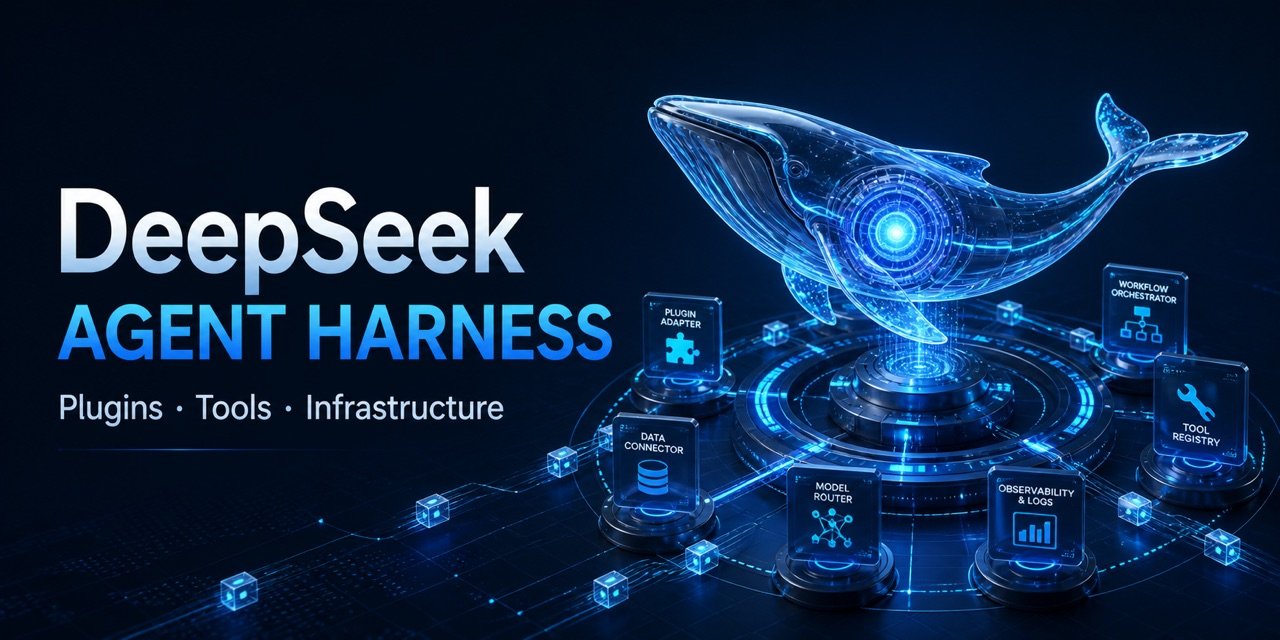
Built upon the Cordis plugin system, DSH decomposes every agent capability into replaceable plugin units:
- Model adapter → plugin
- Tool definition → plugin
- Skill implementation → plugin
- Conversation session management → plugin
- Sandbox runtime → plugin
- Persistent storage → plugin
- Agent main execution loop → plugin
- Task scheduling module → plugin
- UI presentation layer → plugin
Every layer in the stack can be swapped out. Teams are free to drop the default DeepSeek models and connect any OpenAI‑compatible LLM, including locally‑deployed open‑weight models. Developers can replace sandbox environments, customize execution runtimes, or build custom plugins to expand tool sets.
Four Built‑in Preset Modes
DSH ships with four ready‑to‑use agent presets, assembled via different plugin combinations.
| Preset Mode | Positioning | Applicable Scenarios |
|---|---|---|
| Minimal | Lightweight, no search / skill / agent overhead | Simple edits, minimal‑size agent validation, prototype testing |
| Standard | Default configuration, full feature set | Daily coding tasks, bug troubleshooting, project analysis |
| Concurrent‑Search | High‑parallel web‑search capability | Large‑scale data collection, multi‑threaded mission workflows |
| Custom | Fully user‑defined plugin assembly | Specialized workflows for writing workstations and domain‑specific agents |
The Minimal preset corresponds to the “ultra‑light mode” referenced in V4‑Flash official benchmark reports, serving as third‑party validation for DSH framework stability.
Installation
DSH runs locally, keeping all data within the end‑user machine without outbound data leakage.
# One‑line installation (Node.js prerequisite)
npm install deepseek‑harness
# Launch local service after installation
npx deepseek‑harness
# Access via browser: http://localhost:port‑number
# Input DeepSeek API key to initialize
Codex Harness: Embed Agent Capabilities Into Enterprise Software
Released August 19, 2026
- Open‑source license: Apache‑2.0 (includes patent grant clauses)
- Core positioning: *Codex as a Platform*
Codex Harness underpins Codex App, Codex CLI and Codex IDE extensions. OpenAI’s open‑source motivation emphasizes embedding agent capabilities natively inside existing enterprise software products, instead of forcing users to interact inside isolated chat‑box interfaces.
Architecture Design
Codex Harness is a monolithic unified execution framework. It manages these core capabilities internally:
- Conversation state persistence across multi‑turn interactions
- Tool invocation stack: file manipulation, code execution, web search
- Secure‑isolation sandbox environment
- Human‑approval checkpoints for high‑risk operation steps
- Context compression for long‑session token optimization
Unlike DSH’s plugin‑first composability, Codex Harness delivers standardized invocation interfaces. Developers consume exposed APIs rather than modifying internal component graphs. Internals remain opaque; teams integrate agent functions into their own products via SDK or server endpoints.
Three Integration Approaches
# Approach 1: Direct CLI execution (fastest)
codex exec "Analyze security vulnerabilities within this repository"

# Approach 2: SDK integration into your own product
import { CodexHarness } from '@openai/codex‑harness'
const harness = new CodexHarness({ apiKey: 'your‑key' })
const result = await harness.run({ task: '...' })

# Approach 3: app‑server mode for enterprise backend service
codex app‑server --port 3000
The three patterns are oriented toward embedding Codex agent power into existing operation platforms, customer‑service systems, security tooling and internal business applications, instead of building standalone chat interfaces.
Side‑by‑Side Core Dimension Comparison
| Dimension | DeepSeek Harness | Codex Harness |
|---|---|---|
| Release Date | 2026‑08‑13 | 2026‑08‑19 |
| Open‑source License | MIT | Apache‑2.0 |
| Core Philosophy | Everything is plugin, free composability | Embed Agent into enterprise software |
| Architecture Pattern | Plugin‑based Cordis system | Monolithic unified execution runtime |
| Model Binding | No hard binding; model itself is plugin | Deeply optimized for OpenAI‑model stack |
| Operation Mode | Local‑only runtime (gateway localhost) | Local or cloud‑hosted; SDK embedding |
| Developer Learning Barrier | Moderate (requires understanding plugin system) | Low (integration with minimal code) |
| Component Replaceability | Maximum: every layer swappable | Low: consume framework as whole unit |
| Target Audience | Technical developers, research teams | Enterprise product‑engineering groups |
| GitHub Stars | ~37 000 (within six‑day release window) | ~17 000 (one‑day post‑release) |
How To Choose Between The Two Harness Implementations
Select DeepSeek Harness if these match your requirements
- You demand full‑layer control over agent internals, willing to assemble every component manually
- You need flexible switching between different LLMs, custom sandboxes, self‑built skill chains
- You reject rigid vendor locking and hope to swap underlying model backends freely
- High data‑privacy constraints require fully local‑only execution
- MIT license terms satisfy your commercial project requirements
Select Codex Harness if these match your requirements
- You want to inject agent capacity rapidly into existing enterprise systems (operation consoles, customer service, security workflows)
- Your team has mixed technical backgrounds and prefers low‑code‑barrier integration
- You are already an OpenAI‑ecosystem user and do not plan frequent model switching
- Enterprise‑grade conversation state management and human‑approval workflows are mandatory
When neither Harness fits
- If you only need lightweight AI coding assistance: use Claude Code or Codex CLI directly
- If you want multi‑model unified access without building agent runtime from scratch, you may route requests via Treerouter to aggregate various LLM endpoints.
Frequently Asked Questions
Q: Must DeepSeek Harness work exclusively with DeepSeek models?
A: No. The model adapter is just one plugin. DSH supports any OpenAI‑compatible endpoint, including self‑hosted open‑source models. “DeepSeek” refers only to the framework origin, it imposes no model‑vendor constraints.
Q: What is the distinction between Codex CLI and Codex Harness?
A: Codex CLI is a user‑facing command‑line tool. Codex Harness is the underlying execution runtime supporting CLI, App and IDE extensions. After open‑sourcing Harness, developers may build custom front‑ends and tool wrappers on top of it, not limited to OpenAI’s official three clients.
Q: Apache‑2.0 versus MIT license for commercial projects?
A: Both permit commercial use. Apache‑2.0 includes explicit patent‑grant clauses. MIT delivers simpler, minimal text with zero additional obligations. For most business scenarios, both licenses are acceptable; teams should review patent‑related risks when picking Apache‑2.0.
Q: Is cross‑framework interoperability possible?
A: In theory yes. DSH model plugins can point toward Codex‑compatible endpoints, and community members are exploring adapters. However no official cross‑compatibility support exists at time of writing.
Conclusion
DeepSeek Harness and Codex Harness represent two divergent technical paths for AI‑agent execution layers. DeepSeek Harness hands maximum flexibility to developers by exposing replaceable plugin‑based layers, catering toward deep‑technical teams pursuing customization. Codex Harness standardizes agent capabilities as embeddable platform components, letting enterprises add agent logic to existing business systems with minimal engineering overhead. Their near‑simultaneous open‑source release signals the AI industry competition is shifting from pure‑model capability toward execution‑layer infrastructure. Which framework gains wider adoption will shape future agent runtime standards.
Learn more:https://treerouter.com