Abstract
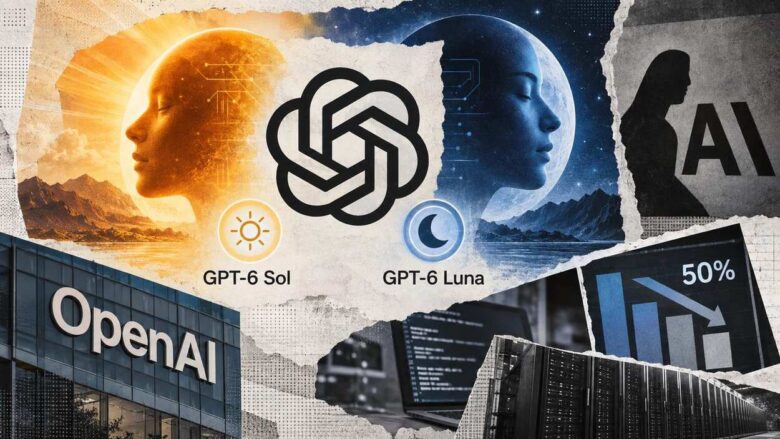
In the early hours of June 27, 2026, OpenAI released GPT-5.6, its latest frontier large language model family. The new lineup includes three tiers: Sol, Terra, and Luna. Each model targets a different workload level, from advanced agentic coding to cost-sensitive batch tasks.
The flagship version, GPT-5.6 Sol, delivers major improvements in code generation, terminal-based workflows, and long-context reasoning. According to the reported benchmark data, Sol reaches 88.8% on Terminal-Bench in standard mode and 91.9% in Ultra mode. This places it ahead of Anthropic’s Claude Mythos 5, which records 88.0% on the same benchmark.
GPT-5.6 also introduces aggressive pricing. Sol is priced at $5 per million input tokens and $30 per million output tokens. This is lower than Claude Fable 5’s reported $10 input and $50 output pricing. For enterprise teams with heavy coding-agent workloads, this creates a meaningful cost advantage.
However, the most important part of this launch may not be technical. The U.S. government has introduced a strict “one-client, one-review” access vetting mechanism. Under this rule, commercial access to GPT-5.6 is limited to a small group of pre-audited enterprises. This marks a major shift in frontier AI commercialization, from broad post-launch access to pre-launch compliance review.
This article explains GPT-5.6’s technical architecture, benchmark results, pricing model, regulatory constraints, global developer impact, and long-term industry implications.
1. GPT-5.6 Launch Timeline and Model Structure
GPT-5.6 was released on June 27, 2026. Unlike previous single-model launches, it adopts a three-tier product structure:
| Model | Positioning | Main Use Cases |
|---|---|---|
| GPT-5.6 Sol | Flagship model | Advanced coding, cybersecurity, long-horizon agents |
| GPT-5.6 Terra | Balanced model | General reasoning, enterprise workflows, document tasks |
| GPT-5.6 Luna | Lightweight model | Batch classification, short dialogue, simple extraction |
This naming system gives OpenAI more flexibility. Each tier can be updated, priced, and optimized separately. Enterprises can also select models based on task complexity instead of using one expensive model for every request.
The full GPT-5.6 family reportedly supports a maximum 1.5 million-token context window. This is a major increase from the prior GPT-5.5 generation, which supported around 1.05 million tokens.
A larger context window is especially useful for:
- Full repository code maintenance;
- Multi-document legal analysis;
- Long customer service histories;
- Cross-week project tracking;
- Multi-step agent workflows;
- Complex cybersecurity investigation.
For developers, this means GPT-5.6 can process larger working memory in a single session. It can retain more code, logs, documentation, and tool outputs before context truncation becomes a problem.
2. Terminal-Bench Results and Coding Performance
The strongest technical highlight of GPT-5.6 Sol is its performance on Terminal-Bench.
Terminal-Bench is more demanding than simple code-completion tests. It evaluates whether a model can operate inside a command-line environment. The model must plan tasks, use tools, debug errors, inspect outputs, and correct itself over multiple steps.
Reported results show a clear lead for GPT-5.6 Sol:
| Model | Mode | Terminal-Bench Score |
|---|---|---|
| GPT-5.6 Sol | Standard | 88.8% |
| GPT-5.6 Sol | Ultra | 91.9% |
| Claude Mythos 5 | Standard | 88.0% |
| GPT-5.6 Terra | Standard | 82.5% |
| GPT-5.6 Luna | Standard | 84.3% |
Sol’s Ultra mode is the strongest result in this comparison. It suggests that the model is especially effective in long, tool-heavy coding workflows.
The difference between standard and Ultra mode is also important. Ultra mode appears to give the model more execution depth. It may be better suited to tasks that require repeated debugging, test execution, and multi-file coordination.
Terra and Luna remain useful, but they are positioned differently. Terra is more suitable for general enterprise tasks. Luna focuses on speed and cost. Neither is designed to replace Sol for complex software engineering work.
3. Improvements Beyond Coding
GPT-5.6 Sol is not limited to programming. The reported launch data also highlights improvements in cybersecurity and biological information analysis.
In cybersecurity tasks, Sol reportedly matches Claude Mythos 5 in vulnerability identification and exploitation-related benchmarks while using only about one-third of the output tokens. This matters for API users because output tokens are often the most expensive part of model usage.
In biological information retrieval and gene-sequence analysis, Sol reportedly reaches a 30% pass rate, compared with 22% for GPT-5.5. This indicates a measurable improvement in specialized scientific reasoning.
These results suggest that GPT-5.6 is designed for high-complexity professional domains. The most relevant use cases include:
- Security code review;
- Vulnerability triage;
- Automated test repair;
- Repository-level debugging;
- Scientific document analysis;
- Long-context research assistance.
The key theme is not only higher accuracy. It is higher efficiency across long, structured workflows.
4. Pricing Strategy: OpenAI Moves Aggressively
OpenAI’s pricing for GPT-5.6 Sol is aggressive compared with Anthropic’s high-end model line.
| Model | Input Price per 1M Tokens | Output Price per 1M Tokens |
|---|---|---|
| GPT-5.6 Sol | $5 | $30 |
| Claude Fable 5 | $10 | $50 |
This makes Sol cheaper on both input and output.
For a team using 50 million input tokens and 10 million output tokens per month, the cost difference can be significant.
A simplified monthly comparison:
| Model | Input Cost | Output Cost | Total |
|---|---|---|---|
| GPT-5.6 Sol | $250 | $300 | $550 |
| Claude Fable 5 | $500 | $500 | $1,000 |
In this example, Sol costs about 45% less.
This pricing strategy is clearly aimed at enterprise coding, DevOps, cybersecurity, and AI-native development teams. These teams often run large numbers of tool calls and generate long outputs. Lower output-token pricing can reduce monthly inference cost quickly.
The strategy may also pressure Anthropic to adjust its pricing for the Mythos and Fable lines. If GPT-5.6 keeps both performance and cost advantages, model selection in enterprise AI coding workflows could shift quickly.
5. The New U.S. “One-Client, One-Review” Rule
The most disruptive part of the launch is the new U.S. regulatory requirement.
According to the report, the U.S. government has introduced a “one-client, one-review” mechanism for GPT-5.6 access. Under this framework, OpenAI cannot simply open commercial access to all qualified customers on its own. Each enterprise client must go through a separate compliance review.
Only about 20 pre-audited U.S. enterprises reportedly received access in the initial phase.
This changes the commercial release model for frontier AI. Previously, AI labs could conduct internal safety testing, launch a model, then respond to misuse after deployment. GPT-5.6 signals a move toward pre-access review.
The regulatory logic is clear. U.S. authorities are concerned that high-performance agentic models may increase risks in areas such as:
- Autonomous vulnerability exploitation;
- Malicious code generation;
- Cyberattack automation;
- Critical infrastructure probing;
- Cross-border misuse of advanced AI systems.
The government’s position appears to be that frontier models with strong terminal automation should not be distributed through normal commercial channels without additional checks.
6. OpenAI’s Public Pushback
OpenAI reportedly issued an unusually direct public statement against making this review process permanent.
The company’s position is that a long-term client-by-client approval system could harm legitimate users. These users include developers, startups, enterprise R&D teams, and cybersecurity defenders.
OpenAI’s concern is not only about access delay. It is also about market fairness.
A strict review process may favor large enterprises with dedicated legal and compliance teams. Smaller developers may face higher friction and slower approval. This could limit innovation and reduce access to advanced tools for independent builders.
OpenAI appears to accept the framework as a temporary preview-stage measure. But it does not want one-client-one-review to become the default model for all frontier AI releases.
This creates a visible tension between two goals:
- National security risk control;
- Fast commercial and developer access.
The GPT-5.6 launch makes that tension public.
7. Impact on Global Developers
The access policy affects more than U.S. companies.
If client-by-client review becomes the global standard for U.S.-origin frontier models, non-U.S. developers may face even higher barriers. They may need to deal with:
- Cross-border network access limits;
- Overseas payment restrictions;
- Regulatory eligibility checks;
- Unclear approval timelines;
- Region-based access exclusions;
- Sudden access suspension risk.
For Chinese developers and enterprises, the impact may be especially strong. Even before this new policy, direct access to many U.S. frontier models was already limited by region and compliance rules.
This may increase the strategic value of domestic models such as GLM-5.2, DeepSeek, Doubao, Qwen, and other localized LLM systems. These models offer more predictable access for local enterprises and can often support private deployment or domestic compliance requirements.
In the long run, the global AI market may become more regionalized. U.S. frontier models may operate under stricter government review. Other regions may build independent model ecosystems to reduce dependence on U.S.-controlled access channels.
8. From Post-Launch Release to Pre-Launch Vetting
GPT-5.6 may mark a turning point in frontier model commercialization.
Before 2026, most model releases followed a post-launch risk model:
Internal safety testing
→ Public or enterprise launch
→ Monitoring
→ Post-launch restrictions if misuse appears
The new model is different:
Internal safety testing
→ Government review
→ Client-by-client approval
→ Limited access
→ Ongoing monitoring
This creates new operational burdens for AI labs. They may need:
- Larger compliance teams;
- Client application review workflows;
- Government reporting systems;
- Access monitoring infrastructure;
- Audit records for each customer;
- Clear rules for suspension and reinstatement.
For developers, the result is more uncertainty.
Advanced models may become harder to access quickly. Enterprise API approval may take longer. Access rights may also depend on government review, not only commercial contracts.
This makes multi-model strategy more important. Teams should avoid designing systems around one frontier model that may become restricted, delayed, or suspended.
9. A Balanced View of GPT-5.6
Technically, GPT-5.6 looks like a major release.
Its main strengths include:
- A three-tier model family;
- A 1.5 million-token context window;
- Strong Terminal-Bench results;
- Ultra mode for advanced workflows;
- Competitive cybersecurity performance;
- Better biological analysis scores;
- Lower pricing than Claude Fable 5.
For enterprises that receive access, GPT-5.6 may provide strong value in coding, DevOps, repository maintenance, automated testing, and security research.
But access restrictions reduce its short-term market impact. A model that only reaches a small group of approved clients cannot spread as quickly as earlier OpenAI models.
The regulatory issue may therefore define this launch more than the benchmark scores. GPT-5.6 is both a technical milestone and a governance milestone.
10. What Developers Should Do Next
Developers should prepare for a future where frontier models are powerful but less predictable in availability.
A practical strategy includes:
- Build multi-model support.
Do not depend on one model or one provider.
- Separate model routing from business logic.
Keep model configuration in a dedicated access layer.
- Maintain fallback models.
Test domestic, open-source, and closed-source alternatives.
- Track workflow-level cost.
Measure cost per accepted pull request, resolved issue, or completed task.
- Prepare for access changes.
Handle rate limits, approval delays, blocked models, and sudden policy changes.
- Use models according to task type.
Use flagship models for complex work. Use lower-cost models for routine tasks.
This approach reduces risk and gives teams more flexibility.
Conclusion
GPT-5.6 is one of OpenAI’s most important releases. Its Sol, Terra, and Luna structure gives developers clearer model choices. Its 1.5 million-token context window improves long-horizon workflows. Its Terminal-Bench scores show strong coding-agent performance. Its pricing also places pressure on competing high-end models.
But this launch will likely be remembered for regulation as much as performance. The U.S. government’s “one-client, one-review” requirement shifts frontier model access from broad commercial launch to client-level pre-approval. OpenAI’s public pushback shows that this new model is still controversial.
For global developers, the message is clear: advanced model access is becoming a technical, commercial, and regulatory issue at the same time. Teams should build flexible AI infrastructure instead of relying on one provider.
For organizations managing multiple model endpoints, treerouter can provide a unified API entry point, centralize model configuration, and simplify switching between supported models. This helps reduce repeated integration work when teams need to compare GPT-5.6 with other frontier or domestic models.