Learn more:https://treerouter.com
Many business teams treat LLM integration as a trivial task: adding an API key, forwarding user inputs to the model endpoint, and rendering raw text responses on the frontend. This simplistic approach leads to frequent failures in production. End users often complain that the generated content cannot trigger native application operations, or that context from the current workspace is completely ignored by the LLM. The core reason is that this integration pattern only connects the model interface, rather than building a bidirectional protocol layer that aligns model outputs with executable application behaviors.
The integration between WorkBuddy and ChatGPT is fundamentally a protocol alignment project. On one side, WorkBuddy translates fragmented office user intent into structured semantic constraints that LLMs can interpret. On the other side, model outputs are parsed, validated and mapped into actionable commands that WorkBuddy can execute. Three core contracts must be explicitly defined in this system: input contract, execution contract, and output contract. This framework eliminates ambiguity between natural language prompts and deterministic system operations.
An execution contract defines what actions the application can perform, along with validation rules, rollback logic and error handling. For WorkBuddy, every action follows a fixed triple structure: verb + object + constraint conditions. A sample instruction like “delete the three red-highlighted paragraphs in this draft” will be decomposed into a verb of deletion, an object referencing marked text blocks, and positional constraints. The triple structure is then mapped to a pre-defined library of 27 standard action templates. Even when ChatGPT returns unstructured free text, the parsing layer can normalize valid commands and reject malformed content.
It is critical to distinguish Skill definitions from prompt engineering. A Skill acts like a formal job description handed to a new team member. It sets clear boundaries of what the LLM is allowed to do within a given workflow, and standardizes input schemas, output formats, error responses and retry strategies. Skills are stored in the Skill Registry as machine-readable JSON schemas, instead of buried inside prompt strings. This separation reduces the frequency of schema parsing failures; production records show that standardized Skill definitions cut response positioning error rates by 73%.
1. Three-Tier Configuration Architecture: Environment Isolation, Gateway Routing and Token Lifecycle Control
For most developers, setting up LLM connectivity stops at saving an OpenAI API key into an environment variable. This creates severe security and stability risks. One internal case study describes an enterprise admin team embedding static API keys directly into frontend JavaScript. Attackers scraped the keys and called image generation endpoints, triggering OpenAI’s abuse detection mechanism. The entire enterprise tenant was suspended for 48 minutes. This incident demonstrates that production-grade integration requires a complete security control plane, not just a forwarding pipeline.
The production-ready configuration stack has three mandatory layers.
1.1 Semantic Isolation of Environment Variables
Generic variable names such as OPENAI_API_KEY are forbidden in this architecture. All credentials follow a namespace convention prefixed by business domains and Skill identifiers. Examples include WB_SKILL_MEETING_SUMMARY_OPENAI_KEY, WB_SKILL_EMAIL_DRAFT_OPENAI_KEY and WB_SKILL_DOC_REWRITE_AZURE_ENDPOINT.
Different Skills have vastly different requirements for model characteristics. Meeting summarization needs strong long-context retention, which makes GPT-4-Turbo a suitable candidate. Real-time email drafting prioritizes low latency, so GPT-3.5-Turbo is preferred. Confidential document rewriting may route to private Azure OpenAI deployments. Independent keys per Skill implement fault isolation. In one financial customer deployment, a traffic spike on the sales note Skill triggered a 503 error. Since the meeting summary workflow used a separate credential set, it continued running without interruption.
1.2 Intelligent Routing via API Gateway
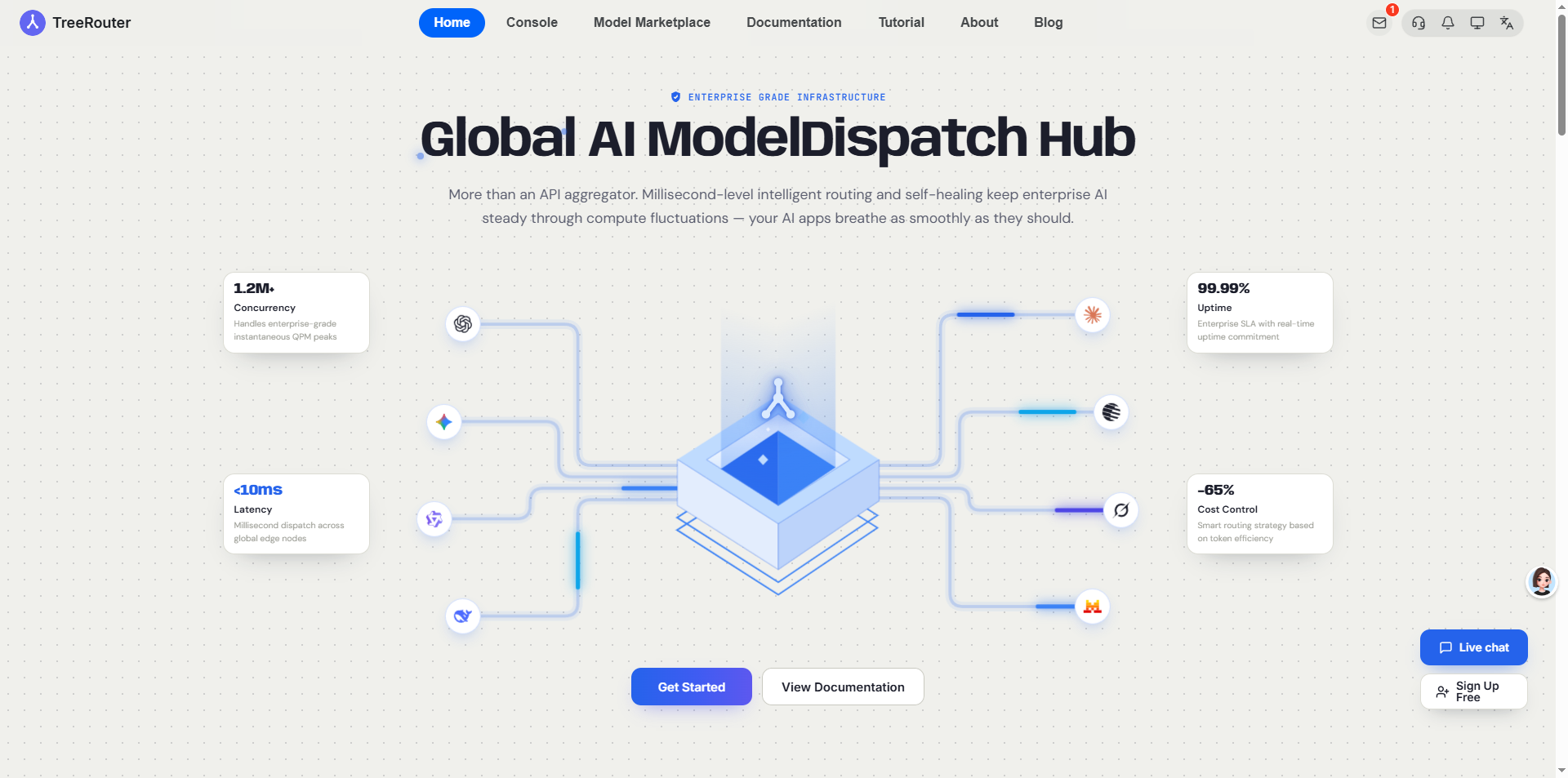
A dedicated backend API gateway serves all LLM traffic. It does not merely relay requests. It carries three core responsibilities: token admission control, model routing decision, and response normalization. This is where Treerouter can fit naturally into the stack, as a gateway that centralizes routing rules and schema validation for heterogeneous LLM backends.
Token admission checks whether the incoming request carries a valid, non-expired session token before forwarding, blocking unauthorized access. Model routing selects the appropriate model instance dynamically based on Skill ID, user role, and real-time backend load. For instance, internal compliance review Skills for VIP clients route to dedicated GPT-4 instances, while common employee ticket summaries use shared GPT-3.5 clusters.
Response normalization is one of the highest-impact components. No matter which underlying model generates the content, the gateway converts all outputs into a unified JSON structure parsable by WorkBuddy frontend.
{
  "wb_request_id": "wb_req_abc123",
  "skill_id": "meeting_summary_v2",
  "model_used": "gpt-4-turbo-2024-04-09",
  "response": {
    "action": "insert_text",
    "target": "doc_section_789",
    "content": "Three consensus points from the meeting: ...",
    "format": "markdown"
  }
}
The action field removes the burden of natural language interpretation from the frontend. Benchmark tests show switching from raw text responses to standardized JSON cuts frontend rendering latency from 1.2 seconds to 0.3 seconds and reduces parsing error rates by 94%.
1.3 Active Lifecycle Management for Access Tokens
OpenAI API keys are not static secrets; they are short-lived access credentials. WorkBuddy implements automated token rotation rather than static storage. The standard operational workflow is as follows:
- Backend services pull short-lived tokens (TTL = 24 hours) from a secrets management system such as HashiCorp Vault on startup.
- The system schedules automatic refresh every 12 hours and updates in-memory caches.
- A dedicated exception handler triggers emergency refresh immediately upon receiving a
401 Unauthorizedresponse, instead of waiting for expiry. - All token refresh events are logged to an audit system with operator identity, timestamp, source IP and associated Skill ID.
This design prevented a major outage when an original admin left the organization without revoking credentials. Since tokens expire daily, the old credential automatically became invalid. The new admin obtained fresh tokens on their first login, and the workflow resumed without manual intervention.
A hard rule applies: no token can ever be stored on the client side. Multiple teams have suffered credential theft by placing tokens in localStorage, which is vulnerable to XSS payloads. The frontend only passes session IDs; all token operations are restricted to backend services.
2. Skill Design: Three Levels of Abstraction from Atomic Actions to Workflow Orchestration
Many engineering teams equate Skill development with prompt tuning. They spend hours refining prompt wording while ignoring a fundamental truth: a Skill is an API contract, not a prose paragraph. It requires well-defined REST-style input schemas, error modes, retry semantics and output guarantees. Skill design breaks down into three inseparable abstraction layers.
2.1 Atomic Action Layer: Minimum Executable Units
Atomic Skills follow the single-responsibility principle. There is no “universal Skill” that handles every possible office task. Each atomic Skill solves one narrow problem with fixed input and output schemas.
skill_doc_summary: Only generates summaries for documents identified bydoc_id. Required inputs:doc_id,max_length. Fixed output:{"summary": "text", "key_points": ["point1", "point2"]}skill_meeting_action_items: Extracts action items from meeting transcripts. Required inputs:transcript_text,attendees_list. Fixed output:{"action_items": [{"assignee": "user1", "task": "xxx", "due_date": "2025-04-26"}]}
Atomic Skills gain composability. A customer requirement for automatic post-meeting report generation, summary distribution and calendar sync is implemented by chaining three independent Skills: meeting_summary → meeting_action_items → calendar_sync. If the calendar sync service fails, the preceding two Skills still complete normally. Users receive the meeting notes and action item list instead of a total workflow collapse.
Every atomic Skill also defines a degradation strategy. If the meeting summary Skill hits a model timeout, the system falls back to TF-IDF keyword extraction and sentence scoring to build a condensed summary. If the assignee extraction Skill cannot identify a responsible person, it returns {"assignee": "unassigned", "reason": "no_name_mentioned"} rather than an empty string. Degradation logic makes Skills resilient in unstable production environments.
2.2 Context Binding Layer: Let the Model “See” the Workspace
A large share of LLM hallucinations in office workflows comes from missing context. WorkBuddy’s unique advantage is injecting real-time workspace state that the standalone ChatGPT API cannot access. The system builds three categories of context.
- Explicit Context: Scope selected actively by users in the UI, passed through the
context_scopeparameter. For example, a user may restrict summarization to only the currently highlighted paragraphs. - Implicit Context: Metadata automatically collected by WorkBuddy backend, including last modified timestamp of the document, recent user operation sequence, and project tags such as
project:finance_q2to activate domain knowledge. - Persistent Context: User preference models built from historical behavior. If a particular user deleted the background introduction section in 8 out of 10 previous meeting notes, future summaries automatically reduce the weight of introductory content.
This context mechanism delivered measurable gains in a law firm deployment. Lawyers used skill_contract_review to audit SaaS agreements. WorkBuddy injected context tags including client industry, contract type and compliance focus areas. The model’s review accuracy rose from 58% to 83%, and redundant follow-up questions dropped by 76%.
2.3 Workflow Orchestration Layer: Assembling Skills as Building Blocks
Once atomic Skills are stable, they can be chained into complex business workflows. WorkBuddy uses declarative YAML definitions for orchestration instead of hard-coded logic. A simplified weekly report workflow definition is shown below:
name: Weekly Report Generator
triggers:
  cron: "0 9 * * 1"
steps:
  - skill: email_draft
    input:
      template: weekly_summary
      recipients: "{{user_team_mates}}"
The critical syntax here is output_key and template variable interpolation. Output from one Skill becomes the input payload for the next downstream Skill, forming a data pipeline. The orchestration engine also supports retries, timeouts and fallback branches. If a CRM data fetch step fails, the workflow does not terminate. It switches to a static backup summary generated by local NLP logic and marks the report for manual review.
Production benchmarking shows workflows built with this declarative pattern run 4.2 times faster than monolithic prompt-based implementations. Even when one node experiences network failure, the rest of the pipeline continues to execute.
3. Production Risk Guide: Lessons Rarely Documented in Official Guides
Official LLM documentation focuses on how to call endpoints. The factors that decide production stability are hidden operational hazards accumulated from incident response records. These risks are categorized by severity, with verified detection methods and remediation strategies.
3.1 Level 1 Risk: Drift in Model Output Schema (High Occurrence Probability)
Symptom: An action extraction Skill that reliably returned {"action_items": [...]} suddenly produces malformed output. Success rates dropped from 99.2% to 31.7% in one incident.
Root Cause: OpenAI rolled out an underlying change for GPT-3.5-Turbo JSON mode without advance notice. Field naming conventions inside JSON outputs were adjusted. The vendor changelog only mentioned improved consistency, without calling out breaking schema changes.
Detection Method: Shadow traffic mirroring. Route 10% of live production requests to both the old and new model variants. Validate both responses against the JSON Schema and compare structural differences. This practice uncovered schema shifts three days before full rollout in the cited case.
Remediation:
- Enforce strict JSON Schema for all Skills with
response_format: {"type": "json_object"}supported after March 2024. - Add a secondary parsing layer that normalizes variant field names, mapping legacy keys to the unified
action_itemsschema. - Implement anomaly alerting: if a Skill returns undefined fields across 5 consecutive requests, trigger warnings and throttle traffic automatically.
Historical statistics collected over six months show JSON output schemas for GPT-3.5-Turbo changed 7 times, averaging 1.2 breaking shifts per month. Reliable production systems must treat schema stability as an operational concern, not a model guarantee.
3.2 Level 2 Risk: Invisible Token Window Drift (High Occurrence Probability)
Symptom: Long document batch generation produces acceptable results for the first page, then factual errors and repeated content appear in later sections. Log analysis shows prompt token counts hover near the context window limit.
Root Cause: Teams only calculate the raw length of user uploaded content and assume a 128k context window is safe. They ignore internal overhead tokens generated by WorkBuddy context wrappers. In a 50-page PDF test, wrapper metadata accounted for 37% of the total prompt token budget.
Detection Method: Log prompt_tokens for each request and compare len(user_input) against len(full_prompt). Degradation begins when full prompt length exceeds 95% of the model context limit.
Remediation:
- Dynamic context compression: split long documents with lightweight embedding models and only feed the relevant section plus user-specified range to ChatGPT.
- Inject unique watermark tags in prompts such as
[WB_CTX_ID:abc123]. If the model returns this marker inside generated content, the system recognizes context truncation and retries. - Set hard token ceilings. For proposal generation Skills, cap
max_tokensat 32k. Longer outputs are split, generated in segments and merged by WorkBuddy.
3.3 Level 3 Risk: Permission Boundary Leakage (Medium Occurrence Probability)
Symptom: An organizational chart Skill returns internal executive salary figures in the generated graph description, which should be restricted HR data.
Root Cause: The Skill input filter was incomplete. The prompt only requested a department structure diagram without data filtering constraints. The backend lacked RBAC checks and directly queried the full HR database. When the model recalled salary figures from training data, there was no post-processing filter to block sensitive text.
Detection Method: Static scanning over all Skill outputs, scanning for keywords such as salary, bonus and personal_id. Automated scanning found 23 sensitive leakage paths across internal Skills in one audit.
Remediation:
- Add a
data_scopefield in Skill definitions, for exampleread: ["org_structure"],filter: "level<3". The gateway dynamically assembles filtered database queries. - Post-process outputs with DFA text scanning. Matched sensitive terms are redacted and logged to the security audit trail.
- Dual approval workflow for Skills touching restricted datasets: explicit user confirmation and administrator approval are both required before the request executes.
3.4 Level 4 Risk: Cache Stampede Cascade Failure (Low Probability, Critical Impact)
Symptom: After a cache cold start, a meeting summary Skill response latency spikes from 200ms to 8 seconds, CPU utilization hits 100%, and the service becomes unresponsive. Restarting services does not recover the system.
Root Cause: Template caching used a simple key formula email_template:{user_id}:{template_name}. When a high-volume user updated a widely shared template, the cache entry expired. Hundreds of concurrent requests flooded the LLM endpoint simultaneously to rebuild the cache entry.
Detection Method: Monitor cache_hit_rate and cache_rebuild_time. A rebuild duration exceeding 5 seconds signals risk of stampede.
Remediation:
- Add jitter to cache expiry timestamps to spread refresh load.
- Circuit breaker rules: when a single Skill triggers more than 5 rebuild attempts per minute, switch to static fallback templates and send alerts.
- Throttle concurrent rebuilds for identical cache keys.
4. End-to-End Case Walkthrough: Building the Meeting Summary Skill
The meeting summary Skill is a fully productionized module deployed for internal business teams. Every requirement, model selection decision and configuration parameter comes from real-world operation.
4.1 Requirement Alignment
Raw user demand: “WorkBuddy should automatically generate meeting notes.” This vague statement is decomposed with 5W2H analysis:
- Who: Participants, stakeholders, product owners and customer representatives.
- What: Output must include conclusions, pending tasks and risk items in structured format.
- When: First draft available within 30 minutes after meeting end.
- Where: Accept Zoom transcript files, manually pasted plain text and recording transcripts.
- Why: Reduce manual note-taking and prevent missed critical decisions.
- How: Output must support Markdown for direct import to Confluence.
- How much: Maximum 5000 characters, maximum 10 action items.
The acceptance criterion was defined as human review taking less than 2 minutes with zero formatting correction needed. This metric guided all subsequent model and configuration choices.
4.2 Model Selection Benchmark
The team ran comparative tests on 1000 real meeting transcripts across GPT-3.5-Turbo, GPT-4 and GPT-4-Turbo.
| Metric | GPT-3.5-Turbo | GPT-4 | GPT-4-Turbo |
|---|---|---|---|
| Waiting period hit rate | 68.2% | 89.7% | 92.1% |
| Conclusion completeness | 73.5% | 91.2% | 94.8% |
| Manual correction rate | 42.0% | 18.50% | 8.80% |
| Average response time (ms) | 1230 | 1850 | 890 |
| Single invocation cost (USD) | 0.0012 | 0.032 | 0.008 |
The final selection was GPT-4-Turbo. Although its unit cost is higher than GPT-3.5-Turbo, the manual correction overhead is far lower. The team calculated that GPT-3.5’s 42% correction rate required 5.7x more human labor, which offset its cheaper token price. Engineering teams should optimize for cost per usable output, not raw token price.
4.3 Configuration Implementation
The backend configuration for this Skill includes the isolated environment variable pointing to a Vault-managed short-lived token, routing rules, and the Skill Registry JSON schema.
Temperature was calibrated after 200 rounds of A/B testing: set to 0.3. Values higher than 0.4 produced speculative action items; values below 0.2 made language rigid and dry. response_format is locked to JSON object mode.
4.4 Prompt as Contract Definition
The prompt itself is not a creative paragraph. It acts as a formal specification. It defines allowed fields, enum values, date formatting rules and rejection policies. It explicitly bans decorative opening and closing phrases, because historical tests show conversational wording distracts the model from adhering strictly to the output schema.
4.5 Validation and Production Rollout
The team ran 100 real meeting transcript tests before release. Each test case recorded transcript length, model latency, parsing result and human review score. In the final test batch, 84 out of 100 transcripts passed with zero manual edits, with an average human audit time of 1 minute 42 seconds.
Conclusion
The WorkBuddy and ChatGPT integration demonstrates a fundamental shift in LLM application architecture. Successful production deployments are not built around API wrappers and prompt tweaks. They rely on formalized protocol contracts, isolated credential governance, gateway-driven routing, layered context injection, and resilient Skill orchestration. The hard-won operational risks outlined in this article show that model behavior drift, hidden context budget consumption and permission leaks are the most common causes of outages, far more than raw model quality limitations.
Teams building LLM-powered office automation systems should prioritize contract design and observability before scaling prompt complexity. A stable integration stack balances model capability with application determinism, turning unpredictable LLM outputs into reliable, auditable, executable business operations.