Introduction
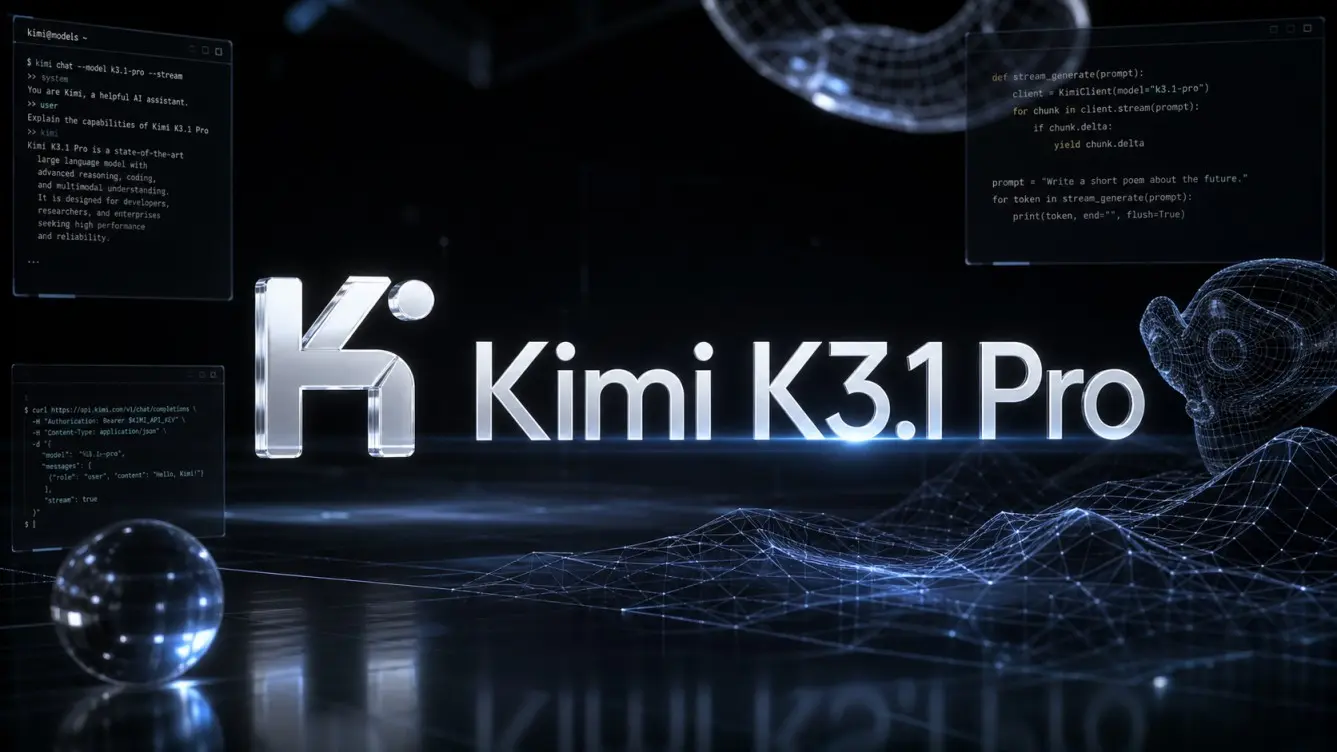
Moonshot AI officially open-sourced Kimi K3 on July 27, 2026. This Mixture-of-Experts foundation model reaches 2.8T total parameters with only 104B activated parameters during each inference pass. Built around three core native innovations: MoonEP for expert parallel communication, FlashKDA for optimized linear attention computation, and AgentENV for persistent agent sandbox environments, K3 delivers stable ultra-long context processing capabilities.
This article systematically introduces three practical deployment approaches: cloud API access, local on-premises inference, and self-hosted industrial agent pipelines. It unpacks architectural design parameters, hardware requirements, license clauses, benchmark performance data, and common engineering pitfalls. For teams running heterogeneous multi-model workloads, an API gateway such as Treerouter can standardize request transformation and unify observability metrics across different model endpoints.
1. Industry Background: Strategic Timing of the Kimi K3 Open-Source Release
Multiple mainstream technology media reported in late July 2026 that 25 leading technology companies jointly published an open letter advocating rational regulatory frameworks for foundation models and opposing premature restrictive measures. The coalition expanded to more than 50 participants within one day. Notably, major Western AI players including OpenAI, Anthropic and Google were absent from the list.
Against this geopolitical backdrop, Moonshot’s decision to fully open-source Kimi K3 carries substantial practical significance, providing accessible high-performance long-context LLM infrastructure for research labs and commercial engineering teams.
2. Core Architecture & Key Technical Specifications
2.1 Hybrid Attention: KDA + Gated MLA
The core design that enables stable million-token context processing. Traditional full Softmax attention suffers from uncontrolled KV Cache memory inflation for extended documents. K3 adopts a dual attention stack:
| Module | Layers | Core Responsibility |
| ---- | ---- | ---- |
| KDA (Kimi Delta Attention) | 24 | Compress long sequential text into cyclical structured state representations |
| Gated MLA | 42 | Preserve fine-grained local information with full-range global retrieval capacity |
The combination achieves a practical balance: linear attention controls memory expansion, while gated multi-head attention retains granular local context details.
2.2 Progressive Layer Read Mechanism
The architecture allows upper transformer layers to directly access feature outputs from preceding layers, mitigating gradual information decay across extended context windows, a pervasive flaw seen in many long-context LLMs.
2.3 Stable Latent MoE Configuration
| Parameter | Value |
|---|---|
| Total Expert Count | 896 |
| Experts Activated Per Token | 16 (activation ratio ~1.8%) |
| Shared Expert Group Count | 2 |
| Total Parameters / Activated Params | 2.8T / 104B |
| Transformer Layers | 93 |
| Vision Encoder | MoonViT-V2 (401M) |
| Activation Function | SITU-GLU |
| Quantization Scheme | MXFP4 weights + MXFP8 activation |
Two critical optimizations guarantee training stability under extreme sparsity:
- SITU-GLU activation: Avoids activation explosion when running under aggressive sparsity;
- Quantile Balancing: Replaces static auxiliary loss functions, dynamically adjusting weights to enforce balanced expert utilization.
3. Practical Mode One: Cloud API Access (Lowest Barrier, Ready Within 5 Minutes)
Developers can access kimi-k3 via the official platform.moonshot.cn endpoint, with native dual-compatible OpenAI and Anthropic request schemas.
Critical Common Pitfall
When running multi-turn dialogue and agent workflows with reasoning enabled, developers must forward the complete original assistant response returned by the API, including `reasoning_content` and `tool_calls`. Discarding the reasoning trace breaks long-chain logical consistency. If intermediate thought data is stripped, the model loses access to prior derivation records and cannot complete subsequent tasks correctly.
Three Key API Usage Guidelines
- The reasoning trace toggle cannot be disabled;
reasoning_contentwill always be present in responses; - Adjust
reasoning_effortbetweenlow,highand default to balance computation depth and latency; - Official benchmark evaluation data is collected under the default reasoning effort setting.
4. Practical Mode Two: Local On-Premises Deployment (Hardware Planning Required)
K3 is distributed as 118 separate binary segments, with 96 expert shards. Even under MXFP4 quantization, full-weight inference requires multi-GPU cluster resources.
Recommended inference engines: vLLM, SGLang and TokenSpeed. The community has released 11 optimized quantization variants compatible with llama.cpp, Ollama, LM Studio and Jan. Official Docker container images are also available.
> Important reminder: Higher quantization compression ratios introduce larger performance degradation compared to baseline unquantized weights.
5. Practical Mode Three: Three Open-Source Infrastructure Projects (Highest Industrial Value)
The three auxiliary repositories are released under permissive open licenses and can be directly integrated into commercial pipelines.
5.1 MoonEP: Expert Parallel Communication Library
Resolves load imbalance issues during distributed MoE training. The core algorithm ensures stable task throughput even when routing skews occur across expert partitions. Key features:
- Strict load balancing across ranks;
- Static shape synchronization to eliminate repeated tensor rearrangement overhead;
- Supports asynchronous checkpointing without triggering expensive OOM recovery cycles.
Official benchmark data shows MoonEP consistently outperforms DeepSeek V2’s communication stack under uneven routing distributions.
5.2 FlashKDA: High-Performance KDA Attention Kernel
CUDA-based native implementation of the Kimi Delta Attention architecture.
Hardware prerequisites: SM90 or newer GPU microarchitecture, CUDA Toolkit 12.9+, PyTorch 2.4+.
5.3 AgentENV: Persistent Agent Sandbox Platform
Dedicated runtime environment for long-cycle autonomous agent experiments. It implements layered memory isolation and state snapshot rollback for multi-step task pipelines. Hardware and kernel prerequisites must be strictly followed to avoid runtime crashes.
6. License Terms for Commercial Adoption
The Kimi K3 open-source license is neither MIT nor Apache 2.0; it contains explicit commercial threshold clauses.
The baseline grant permits use, modification, distribution and hosted deployment, subject to two trigger conditions:
- If monthly revenue from SaaS services built upon K3 exceeds 2 million USD, teams must negotiate a separate commercial agreement with Moonshot AI;
- Public-facing products utilizing K3 are required to display clear attribution labeling.
Different commercial scenarios carry distinct compliance obligations, and teams need to evaluate licensing risks before large-scale rollout.
7. Benchmark Performance Overview
Head-to-head public evaluation results against Claude Opus 5, GPT-5.6 Sol and other flagship models demonstrate differentiated strengths:
- K3 achieves competitive top-tier results on long-document QA and multi-file repository coding benchmarks;
- Mathematical symbolic reasoning performance sits slightly behind leading global flagship models;
- Under ultra-long context compression tests, the dual attention architecture reduces cross-section information loss significantly.
8. Troubleshooting & Common Misconceptions
- Discarding reasoning trace breaks agent consistency: Always retain complete
reasoning_contentin dialogue history; - Quantization inevitably erodes benchmark scores: Test target workloads under different bit-width schemes before production;
- MoE expert imbalance risk: Leverage MoonEP during distributed training to mitigate routing skew;
- AgentENV kernel prerequisites: Older Linux distributions or outdated GPU firmware cause unstable sandbox execution.
9. Conclusion
The open-sourcing of Kimi K3 provides industrial teams with a complete end-to-end long-context LLM stack: the foundation model itself plus three reusable infrastructure toolkits for distributed MoE training, optimized attention computation and persistent agent environments.
Teams can adopt three distinct adoption paths: fast cloud API integration for prototyping, on-premises deployment for data-sensitive scenarios, or building custom agent platforms using the accompanying open infrastructure. Careful evaluation of hardware costs, license commercial thresholds and reasoning trace handling logic will avoid most production engineering pitfalls. As open MoE foundation models mature, standardized routing middleware and distributed communication libraries become essential building blocks for scalable AI application construction.